
In this article
The short version
Ask for the quote itemised with item numbers. It makes them comparable.
Most gaps are explained by one quote including what the other leaves out.
Send the itemised quote to your health fund before you agree to anything.
You get two quotes for what sounds like the same problem. One is $900. One is $2,400. Your instinct is that somebody is overcharging you.
Occasionally that is true. Far more often, the two quotes are not for the same treatment at all, and once you know how to read them, the difference usually explains itself. Here is how to tell, without needing a dental degree.
Start with the item numbers
Every dental treatment in Australia has a standardised item number. A quote should list them. If yours does not, ask. You are entitled to an itemised quote before you agree to anything, and any practice will provide one.
Item numbers are what make two quotes comparable. Without them you are comparing a total against a total, which tells you almost nothing. With them, you can put the two side by side and see exactly where they diverge.
Nine times out of ten, the gap is one of the four things below.
1. One quote includes the thing the other one leaves out
The classic example is a crown. A tooth that needs a crown sometimes also needs root canal treatment first, and sometimes needs a build-up underneath the crown to give it something to sit on.
Quote A might be the crown alone. Quote B might be the root canal, the build-up and the crown. Same tooth, same eventual outcome, wildly different number, because one of them is telling you the whole cost now and the other will tell you the rest later.
This is the single most common reason quotes differ, and it is worth asking directly: is there anything else this tooth is likely to need, and is it in this figure?
2. The materials are genuinely different
Crowns can be made from several materials with real differences in strength, appearance and cost. Dentures range from a basic acrylic plate to a precision cobalt-chrome framework that fits better and lasts longer. Implants come from a range of manufacturers, and the cheaper systems are sometimes ones that will be difficult to get parts for in fifteen years.
None of that means dearer is automatically better for you. A back tooth nobody sees may not need the most aesthetic material available. But it does mean “a crown” is not one product with one fair price.
3. One of them has planned for the tooth next door
Dentists differ, legitimately, in how far ahead they treat. One might quote to fix the tooth that hurts. Another might quote to fix that tooth plus the two showing early decay on the x-ray, on the grounds that you are here now and those will be holes within a year.
Both are defensible. But they are different plans, and comparing their totals is meaningless.
4. Complexity that is not visible from the outside
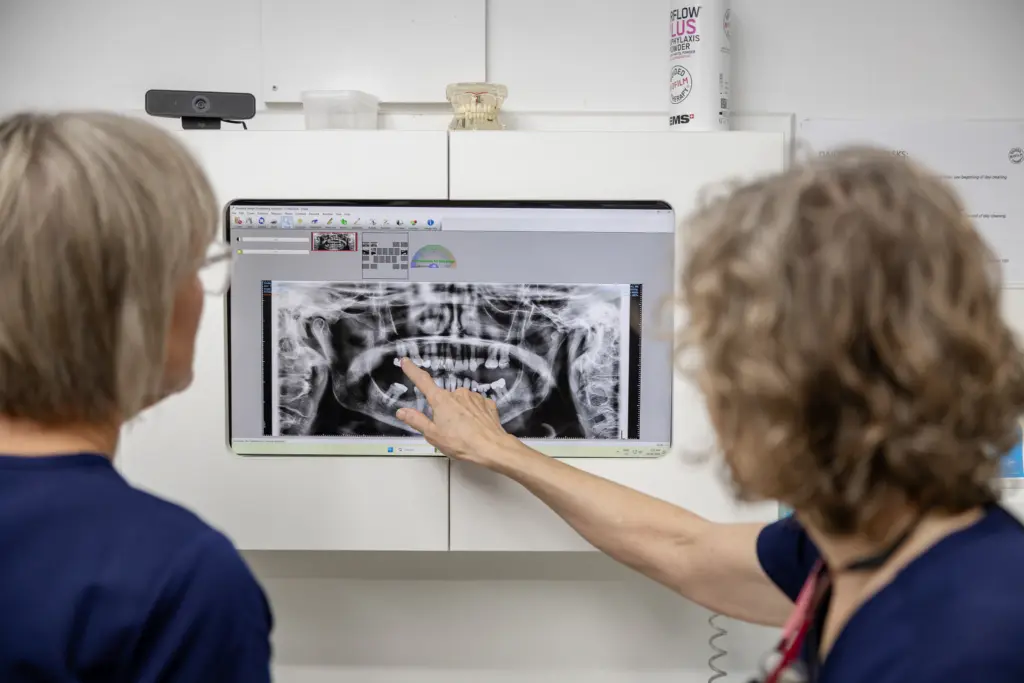
A tooth that has been filled several times, sits at an awkward angle, or has a root that curves is more work than a straightforward one, and the fee reflects it. An x-ray shows this; a glance in the mirror does not.
The three questions worth asking
You do not need to become an expert. You need three questions.
- “Can I have this itemised with item numbers?” This is the one that makes everything else possible.
- “What happens if I do nothing for six months?” A fair answer will distinguish between this will be significantly worse and cost more and we can watch this. If everything on the list is urgent, that is worth a second opinion.
- “Is there a cheaper option that is still a reasonable thing to do?” Often there is: a well-made large filling instead of a crown, a partial denture instead of an implant. It may not last as long, and you are entitled to know that trade-off and to choose it.
Your health fund is not a discount
Two quotes can be identical and still cost you differently, because of how your fund treats them.
- Annual limits. Most extras policies cap what they will pay per year. Big treatment split across two calendar years can mean two limits instead of one, worth asking about if the timing is flexible.
- Waiting periods. Major dental usually carries a twelve-month wait. Switching funds for a better rebate rarely works if you need treatment now.
- Preferred provider arrangements. A fund may pay more at practices it has an agreement with. That changes your gap, not the quality of the work.
- Pre-approval. For anything substantial, send the itemised quote to your fund first and ask what they will actually pay. They will tell you in writing, and then you know your real number rather than an estimate.
When a low quote is worth a second look
Not to be cynical about it, but if one quote is dramatically lower, find out why before you assume you have found a bargain. Sometimes the answer is completely reasonable: a simpler plan, a different material, lower overheads. Sometimes it is a staged fee where the rest arrives later. Ask which.
The reverse is also true. A higher number is not proof of better care, and no one should be talked into treatment on the basis that expensive means thorough.
Where we stand
We would rather lose an appointment than sell you something you do not need, and we will say so plainly when a tooth can be watched rather than treated. That is not a marketing position, it is just easier. We tend to see the same families for decades, and a treatment you did not need is a conversation we would have to have again in five years.
Fairness here means you get the whole picture before you decide: what we can see, what it will cost, what happens if you leave it, and what the cheaper option would be if there is one. Nothing gets started until you have said yes to a number you have actually seen.
If you have a quote from somewhere else and you simply want it explained (not undercut, explained), bring it in. Understanding what you are being asked to pay for is part of helping patients access the care they deserve, and it costs nothing to ask.
Get in touch if you would like a written, itemised quote, or read more about the routine care that keeps most of this from being necessary in the first place.
Not sure your technique is working?
We will show you on your own teeth where you are missing.